
Washing machines.

We have documented 697 washing machines fault codes from published technical sources. 641 of them (92%) also carry the cause, not just the meaning. The most frequent subjects are control board, door or lid lock, motor and drive. On 116 codes the same code means different things depending on the brand — always check yours.
Most frequent fault codes
Each code below comes from a published source, with the cause and the check to run. We never invent a cause we cannot document.
| Code | What it means | Cause & what to check |
|---|---|---|
| E02 | Water inlet fault machine not filling within the expected time | Tap closed or partially closed. Kinked or trapped inlet hose. Blocked inlet hose filter. Low mains water pressure. Failed inlet valve solenoid. In cold weather, frozen inlet hose. |
| E03 | Drain / pump fault machine unable to drain water within the expected time | Blocked pump filter (the most common cause). Kinked or blocked drain hose. Standpipe too high. Foreign object blocking the pump impeller. Failed drain pump motor. Wiring fault to drain pump. |
| E04 | Overfill / overflow detected pressure sensor reading too much water | Excessive foam from too much detergent (most common cause). Wrong type of detergent (standard detergent in an HE machine). Overloading creating excessive sudsing. Inlet valve stuck open allowing continuous fill. Pressure sensor fault. |
| E05 | Heater failure water not reaching target temperature | Failed heating element. Failed NTC thermistor. Faulty control board. Wiring fault between element or thermistor and control board. Limescale heavily fouling the element in hard water areas. |
| E07 | Pressure switch / level sensor fault | Failed pressure switch. Blocked or kinked pressure switch hose. Soap suds blocking the pressure system. Wiring fault to pressure switch. |
| E08 | Wash heater triac fault control board fault on heating circuit | Failed triac on the main control board. Heating relay stuck on causing continuous heating. Wiring fault. |
| E09 | NTC thermistor fault variant | Failed NTC thermistor. Wiring fault to the thermistor. Limescale on thermistor in hard water areas. |
| E1 | Door latch / lock fault machine not detecting the door is closed and locked | Door not fully closed. Failed door interlock mechanism. Wiring fault to the interlock. Obstruction in the door seal. Broken door handle or catch. |
| E10 | Drainage / drain time exceeded variant of E03 | Blocked pump filter. Kinked drain hose. Pump fault. Standpipe too high. |
| E11 | Heating timeout water not reaching target temperature within expected time | Failed heating element. Failed NTC thermistor. Wiring fault. Limescale heavily fouling the element. |
| E12 | Communication fault between modules | Internal communication breakdown between control modules. Wiring harness fault. Module failure. Moisture damage. |
| E13 | Door lock variant on some models | Failed door interlock or wiring fault on models that use E13 rather than E01 as the primary door lock code. |
| E4 | Water heater problem machine not heating water correctly | Failed heating element. Failed NTC thermistor. Wiring fault between element or thermistor and control board. Limescale heavily fouling the element in hard water areas. Faulty control board. |
| E8 | Heating circuit fault control board not detecting correct heating circuit operation | Failed heating element. Failed NTC thermistor. Triac fault on control board. Wiring fault. |
| E9 | Heating timeout / NTC thermistor variant | Heating taking too long to reach target temperature. Failed thermistor giving incorrect reading. Limescale on element preventing efficient heating. Wiring fault. |
| E10 Aeg | Water fill fault machine not filling or fill taking too long | Tap closed or partially closed. Kinked or trapped inlet hose. Blocked inlet hose filter mesh. Low mains water pressure. Failed inlet valve solenoid. Aquastop hose triggered or blocked. |
| E11 Aeg | Slow or incomplete fill fill taking longer than expected | Partially blocked inlet filter reducing flow rate. Mains water pressure borderline low. Inlet valve solenoid partially failing and not opening fully. |
| E12 Aeg | Water level sensor not confirming fill has completed | Blocked or kinked pressure switch hose preventing the pressure switch from reading the water level. Failed pressure switch. Soap suds blocking the pressure chamber. |
| E13 Aeg | Anti-flood device triggered water detected in the machine base | Water has entered the base tray triggering the float switch. Possible sources include a failed door seal, leaking pump, cracked internal hose, or inlet valve fault. |
| E1x Aeg | Water fill system | E10, E11, E12, E13 |
| E20 Aeg | Drain fault machine unable to drain within expected time | Blocked pump filter. Kinked or obstructed drain hose. Standpipe too high. Foreign object blocking the pump impeller. Failed drain pump motor. |
| E21 Aeg | Slow drain machine draining but taking longer than expected | Partially blocked pump filter. Partial blockage in drain hose. Pump impeller sluggish but not failed. |
| E22 Aeg | Drain pump monitoring fault pump running but flow not confirmed as expected | Partially blocked pump. Pressure switch hose issue causing incorrect water level reading during drain. Pump capacitor beginning to fail. |
| E23 Aeg | Drain pump motor failure | Failed drain pump motor. Failed pump capacitor. Wiring fault to pump. |
| E24 Aeg | Drain pump relay fault board relay controlling the pump has failed | Failed relay on the main PCB. Board-level fault. |
| E2x Aeg | Drain system | E20, E21, E22, E23, E24 |
| E33 Aeg | Incongruency between pressure switch readings the two water level monitoring systems are not in agreement | Hydraulic circuit blockage. Failed electronic pressure switch. Failed secondary pressure switch. Wiring fault. Main PCB fault. |
| E34 Aeg | Incongruency between pressure switch and secondary water level sensor | Disagreement between two water level monitoring components. Pressure switch fault, secondary sensor fault, wiring or PCB fault. |
| E35 Aeg | Water level too high overfilling detected | Inlet valve not closing fully. Failed pressure switch reading level incorrectly. Pressure switch hose blocked causing false high reading. |
| E39 Aeg | Anti-flood device or high-voltage pressure switch fault | Anti-flood float triggered. HV pressure switch fault. Internal leak. |
| E3x Aeg | Pressure switch and water level system | E33, E34, E35, E36, E37, E39 |
| E40 Aeg | Door lock fault general group code | See E41 to E45 for the specific cause. |
| E41 Aeg | Door open machine not detecting the door is closed | Door not fully latched. Obstruction in door seal. Failed door interlock not registering as closed. Broken door handle or catch. |
| E42 Aeg | Door lock mechanism fault mechanical locking failure | Failed door interlock mechanical component. Door catch worn. Door handle linkage broken. |
| E43 Aeg | Door lock control circuit fault | Wiring fault between door interlock and control board. Faulty control board door lock circuit. |
| E44 Aeg | Door open signal not received by control board | The interlock is physically locked but the board is not receiving the confirmation signal. Wiring fault. Failed interlock signal circuit. |
| E45 Aeg | Door lock relay fault relay on PCB controlling door locking | Failed relay on main PCB controlling the door lock mechanism. |
| E4x Aeg | Door lock system | E40, E41, E42, E43, E44, E45 |
| E50 Aeg | Motor fault general group code | See E51 to E54 for specific cause. On older machines without sub-code display, E50 most commonly indicates worn carbon brushes. |
| E51 Aeg | Motor power triac short circuit triac on PCB has failed | The triac component on the main control board that controls motor power has short-circuited. May also cause the machine to trip the RCD. |
What actually breaks
Counted on the 697 codes on this page, not estimated.
| subject | codes | share |
|---|---|---|
| control board | 288 | 41% |
| door or lid lock | 211 | 30% |
| motor and drive | 161 | 23% |
| sensors | 148 | 21% |
| water fill | 129 | 19% |
| heating | 87 | 12% |
| drainage | 79 | 11% |
| load balance | 15 | 2% |
The parts that fail
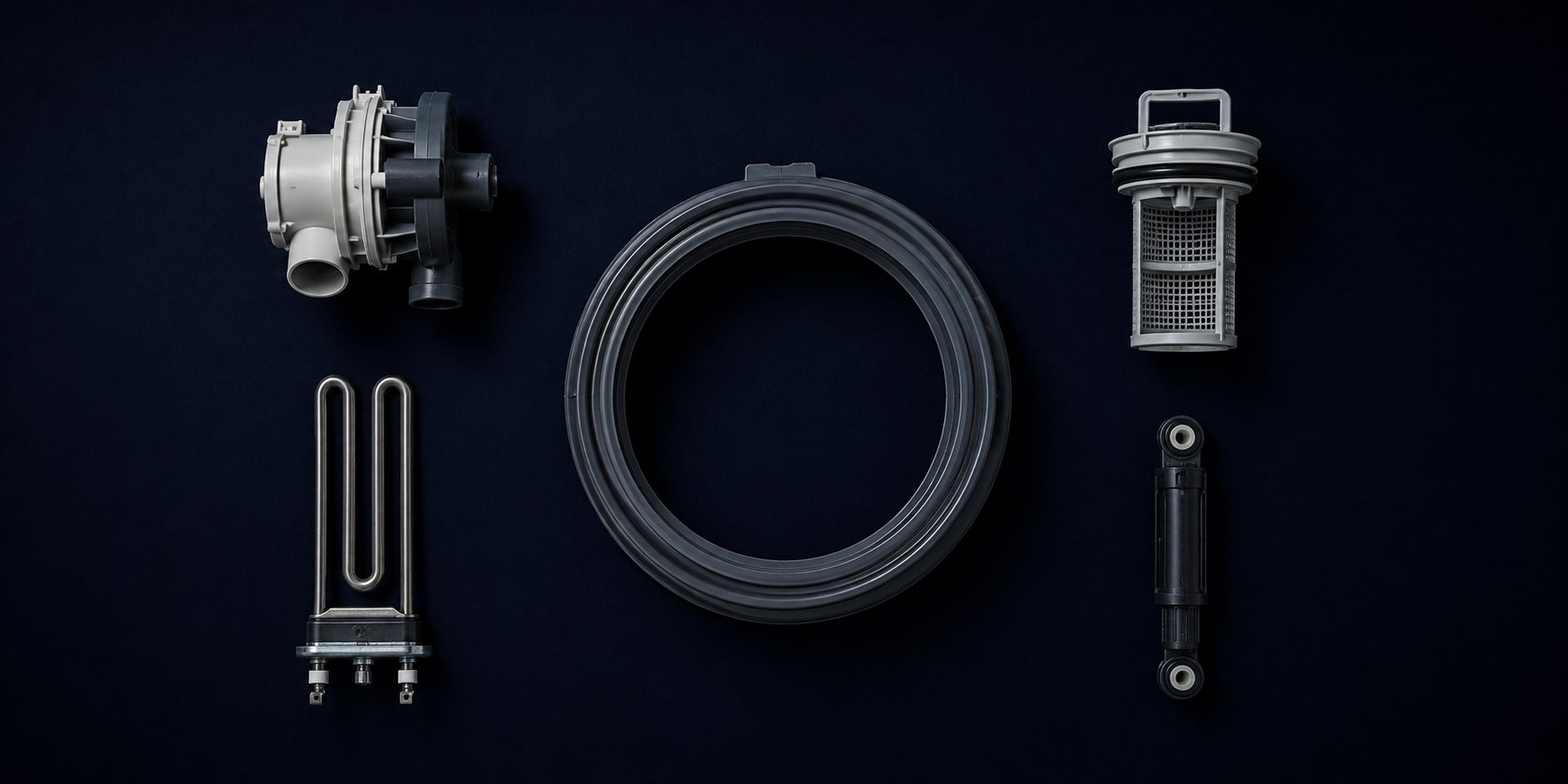
The components behind the codes above: pump, heating element, seal, filter.
Brands covered
Frequently asked questions
Answers counted on our own data, with the sources cited at the bottom of the page.
What is the most common washing machines fault code?
In our data the code that appears on the largest number of brands is E10. On Aeg it means: Water fill fault machine not filling or fill taking too long
Does the same code mean the same thing on every brand?
No, and this is the single most useful thing to know. We found 116 codes that appear on two or more brands with different meanings. For example E10: on Aeg it means «Water fill fault machine not filling or fill taking too long», on Akai it means «Inverter failure».
What goes wrong most often on a washing machines?
Counting the causes we documented: control board (41%), door or lid lock (30%), motor and drive (23%), sensors (21%). This is what the codes actually describe.
Which brands are covered?
For washing machines we currently document codes for: Kenmore, Zanussi, Aeg, Frigidaire, Whirlpool, Ge, Candy, Lg, Hotpoint, Indesit, Daya, Hoover, Beko, Bosch, Hisense, Akai, Haier, Gorenje, Midea, Blomberg, Maytag, Samsung, Speed Queen, Comfee. The list grows as we verify new sources.
Independent reliability
scores for every appliance.
Beyond fault codes and specialists, we rate the reliability of appliance brands and models — a transparent score that owes nothing to the manufacturer. The reference to check before you buy or repair.