

Dishwashers.

We have documented 206 dishwashers fault codes from published technical sources. 146 of them (71%) also carry the cause, not just the meaning. The most frequent subjects are sensors, water fill, door or lid lock. On 33 codes the same code means different things depending on the brand — always check yours.
Most frequent fault codes
Each code below comes from a published source, with the cause and the check to run. We never invent a cause we cannot document.
| Code | What it means | Cause & what to check |
|---|---|---|
| E16 | Unexpected water fill. Water entering the unit when it shouldn't be. Faulty inlet valve — | replace immediately |
| E11 Beko | Spray arm rotation blocked | Check for tall items blocking arm; remove and clean spray arm pivot |
| E12 Beko | Salt reservoir sensor error | Refill salt; check sensor float mechanism |
| E13 Beko | AutoDose reservoir empty | Refill the detergent reservoir with liquid HE dishwasher detergent |
| E14 Beko | AutoDose dispenser motor jammed | Remove reservoir, clean dispenser mechanism, check for crystallized detergent |
| E15 Beko | AutoDose calibration error | Run AutoDose calibration cycle (consult manual for procedure) |
| E16 Beko | Water hardness sensor error | Clean sensor; recalibrate water hardness setting |
| E17 Beko | Door latch micro-switch fault | Inspect latch alignment; test switch continuity |
| E18 Beko | Water leak at spray arm seal | Tighten spray arm nut; replace worn gasket |
| E0 Bosch | No fault codes are recorded | No component problems were detected. When you enter the diagnostic test mode and retrieve saved fault codes from the control memory, this E0 code is displayed when no fault code was recorded |
| E08 Bosch | Heating / temperature control error | high |
| E1 Bosch | Heating problem | Check the water fill level. If water level is too low, the heater won't turn on. If the water level is okay, the flow switch or the heater could be defective. A service technician usually needs to diagnose and repair a heating failure because accessing the heater requires removing the dishwasher tub |
| E12 Bosch | Limescale build up | Dishwashers are used on a regular basis which means that limescale can build up quickly, especially in hard water areas. To keep your dishwasher working as efficiently and effectively as possible, and to ensure your dishes come out perfectly clean, regular de-scaling is important |
| E14 Bosch | Flow meter failure | Indicates a flow meter failure or an issue with water flowing into the dishwasher or the filling system |
| E15 Bosch | Water in the base trough | Indicates that the safety switch has detected water in the base of the dishwasher. Your leakage protection system has activated. Need to check why water is leaking into the base. |
| E16 Bosch | overfill detected, E17 = underfill. If E16 | check that drain hose has a proper high loop (anti-siphon) — backflow from disposal is the most common cause of phantom overfill in installations |
| E18 Bosch | Water flow into the dishwasher | Indicates there is an issue with water flow into the dishwasher. The cause of this error code happens when the water level is too low, or water is not being pumped correctly |
| E2 Bosch | Temperature sensor defective | A service technician usually needs to diagnose and repair a temperature sensor problem because accessing the sensor requires removing the dishwasher tub |
| E22 Bosch | Filter is blocked | Indicates that the dishwasher filter is blocked. The filter is the area where food particles get caught and it needs to be cleaned regularly. Remove the filter to make sure it is not clogged |
| E23 Bosch | Issue with drain pump | Indicates there is an issue with the drain pump. This happens when the drain pump is blocked, clogged, or faulty |
| E24 Bosch | Dishwasher not draining | It means that the dishwasher is not draining properly due to the drain filter being blocked |
| E25 Bosch | Drain pump blocked, drain issue, filter clogged or pump impeller is jammed | Indicates the drain pump is blocked or the drain pump cover is loose or missing |
| E3 Bosch | Not filling | If the water supply cut-off valve for the dishwasher is fully open and the dishwasher still won't fill, shut off the water supply, unplug the dishwasher, disconnect the fill line and check whether the screen in the water inlet valve is clogged. If it's clogged, replace the water valve-don't just clean the screen, because debris could fall into the valve body, prevent the valve from closing, and cause flooding. If the dishwasher still won't fill, have a service technician diagnose and repair the dishwasher |
| E4 Bosch | Water switch defective | A service technician usually needs to diagnose and repair a water switch problem because accessing the sensor requires removing the dishwasher tub |
| E5 Bosch | Overfilled | Unplug the dishwasher or shut off the house circuit breaker to disconnect electrical power. If the dishwasher continues to fill, replace the water inlet valve assembly |
| E6 Bosch | Aqua sensor defective | The aqua sensor detects how dirty the water in the dishwasher is. A service technician usually needs to diagnose and repair an aqua sensor problem because accessing the sensor requires removing the dishwasher tub |
| F1 Bosch | Flood switch error | high |
| F2 Bosch | Motor problem | high |
| F3 Bosch | Temperature sensor error | medium |
| F4 Bosch | Faulty sensor / element | high |
| H24 Bosch | 24 hour delay | Unplug dishwasher for 3 minutes to reset |
| F2 Dacor | Water inlet valve won't shut (keeps filling) | Unplug the dishwasher or shut off the house circuit breaker to disconnect electrical power. If the dishwasher continues to fill, replace the water inlet valve. If filling stops when you disconnect power, replace the electronic control board |
| F3 Dacor | Low inlet water pressure (long fill time) | If the water supply cut-off valve for the dishwasher is fully open and the dishwasher still fills slowly, shut off the water supply, unplug the dishwasher, disconnect the fill line and check whether the screen in the water inlet valve is clogged. If it's clogged, replace the water valve-don't just clean the screen, because debris could fall into the valve body, prevent the valve from closing, and cause flooding. Check the wiring connections on the inlet water valve and secure any loose connections. If the water valve won't open when activated, replace it |
| F4 Dacor | No signal from the water pressure switch | Unplug the dishwasher or shut off the house circuit breaker to disconnect electrical power. Remove the lower access panel. Check wire harness connections. Reconnect any loose wires on wire harness for the water pressure switch. Replace the wire harness if damaged. If the wire connections are okay, replace the water pressure switch |
| F5 Dacor | Defective electronic control board | Disconnect the electrical power supply from the dishwasher for 3 minutes to reset the electronic control board. If the error code appears after you restore power, replace the electronic control board |
| F9 Dacor | Heater failure | Examine and repaired the inline flow-through heater |
| Er-01 Electrolux | Water leak detected | A sensor under the dishwasher detected a leak. Shut off power to the dishwasher. Inspect all hoses, pumps and the tub to find the leak. Replace the leaking parts |
| Er-02 Electrolux | Thermistor/turbidity sensor failure | Shut off power to the dishwasher and check the wiring for the thermistor/turbidity sensor circuit. If the wiring is okay, replace the thermistor/turbidity sensor |
| Er-03 Electrolux | Wash motor failure | Shut off power to the dishwasher and then check the wiring for the wash motor. If the wiring is okay, check for an obstruction in the pump. Replace the wash motor if the pump is clear and the wiring is okay |
| Er-06 Electrolux | Lower fan failure | Shut off power to the dishwasher and check the wiring for the lower fan. If the wiring is okay, replace the lower fan |
What actually breaks
Counted on the 206 codes on this page, not estimated.
| subject | codes | share |
|---|---|---|
| sensors | 50 | 24% |
| water fill | 38 | 18% |
| door or lid lock | 36 | 17% |
| heating | 22 | 11% |
| drainage | 22 | 11% |
| control board | 20 | 10% |
| motor and drive | 17 | 8% |
The parts that fail
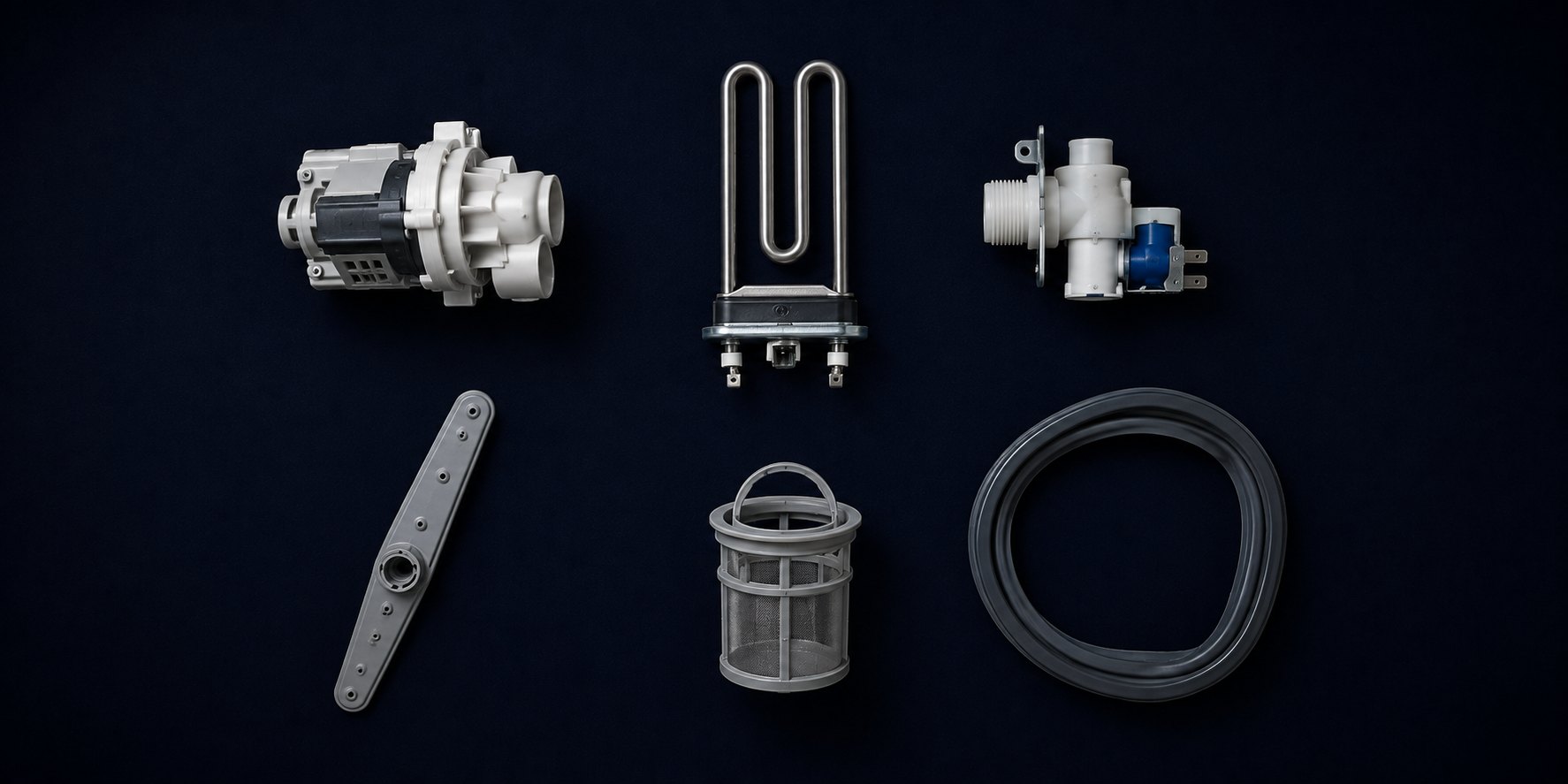
The components behind the codes above: pump, heating element, seal, filter.
Brands covered
Frequently asked questions
Answers counted on our own data, with the sources cited at the bottom of the page.
What is the most common dishwashers fault code?
In our data the code that appears on the largest number of brands is E1. On Bosch it means: Heating problem
Does the same code mean the same thing on every brand?
No, and this is the single most useful thing to know. We found 33 codes that appear on two or more brands with different meanings. For example E1: on Bosch it means «Heating problem», on Fisher Paykel it means «Water Fill Error».
What goes wrong most often on a dishwashers?
Counting the causes we documented: sensors (24%), water fill (18%), door or lid lock (17%), heating (11%). This is what the codes actually describe.
Which brands are covered?
For dishwashers we currently document codes for: Ge, Bosch, Electrolux, Beko, Kenmore, Fisher Paykel, Hisense, Lg, Frigidaire, Whirlpool, Midea, Dacor, Insignia, Miele, Kitchenaid, Maytag. The list grows as we verify new sources.
Independent reliability
scores for every appliance.
Beyond fault codes and specialists, we rate the reliability of appliance brands and models — a transparent score that owes nothing to the manufacturer. The reference to check before you buy or repair.