

Mulch Calculator: Volume, Bags & Cost
Calculate how much mulch or bark you need for garden beds and tree rings. Estimate cubic yards, litres, whole bags and cost using supplier prices.
Metric and US units · 24.11.2026
How to use
- Choose your country and units.
- Enter each area; subtract non-overlapping openings.
- Enter the depth of the new layer. For a top-up, enter only the missing depth.
- Enter the bag volume and optionally a bulk or bag price.
Project calculator
Add positive areas and subtract openings. Exclusions must not overlap or extend outside the project.
Order volume
Results update automatically
Quantity breakdown
Bulk cost uses the order volume. Bag cost uses whole bags. Delivery is excluded.
From bed area to mulch volume
Subtract paths and unmulched openings once. Multiply the remaining area by the new layer depth, then apply your order allowance once.
Bark, wood chips and leaf mulch can have different bulk densities. Moisture changes weight. Without a supplier value, the weight field stays empty.
Worked example
A 10 × 5 m bed, a 5 cm layer and 40 L bags, with no allowance.
50 m² × 5 cm = 2 500 L
2 500 L ÷ 40 L = 62.5
63 × 40 L = 2 520 L
One allowance covers handling losses or settlement. Use zero if the supplier’s coverage already includes it.
Buying bags or bulk mulch
For an L-shaped bed, add two non-overlapping rectangles. For a tree ring, subtract the inner circle from the outer one. Both circle inputs use radius.
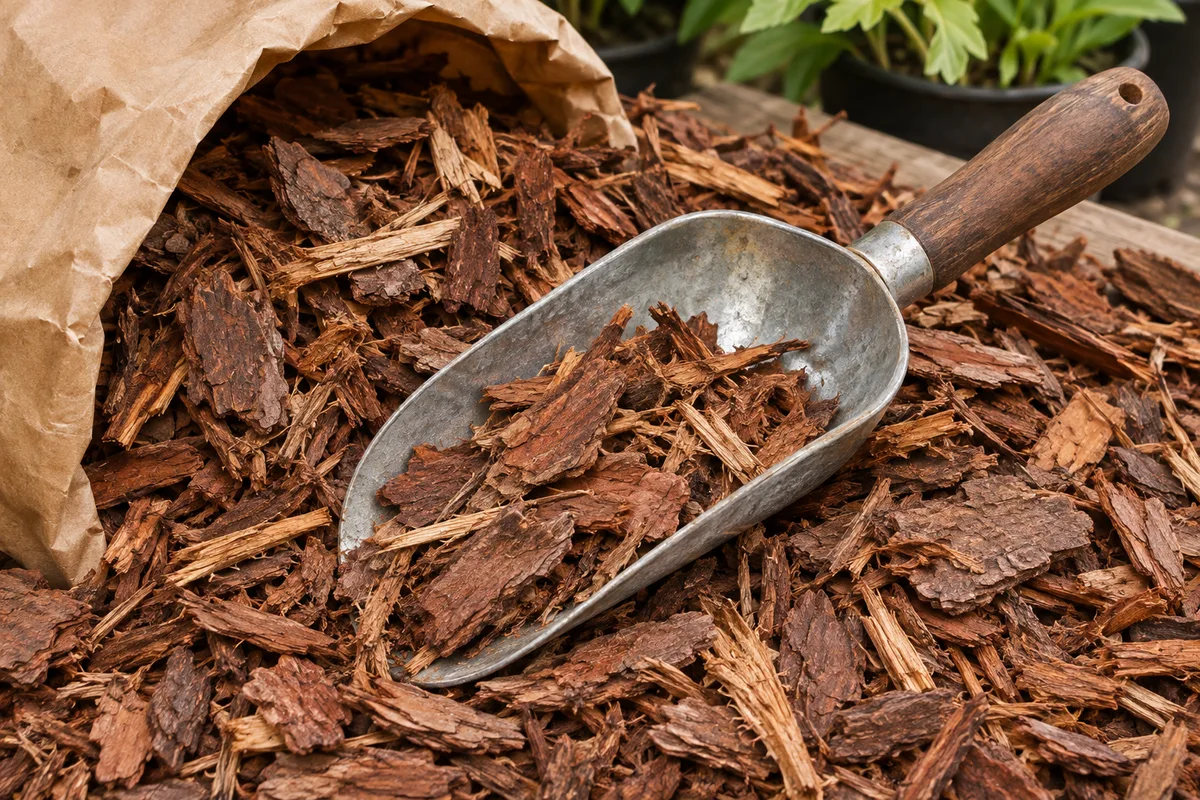
Check whether a compressed bale states packed volume or volume after expansion. Use the spreadable yield per pack from the supplier.
Check the billed unit before comparing quotes. A cubic yard is 27 cubic feet. A 100 ft² bed at 3 in takes 25 ft³, or 13 bags of 2 ft³.
How much mulch do I need per square foot or metre?
For each square metre, every centimetre of depth needs 10 litres. In US units, multiply square feet by depth in inches and divide by 324 to get cubic yards. Divide total volume by bag capacity and round up.
| Depth | Litres per m² | Area per 50 L |
|---|---|---|
| 2 cm | 20 L | 2.5 m² |
| 3 cm | 30 L | 1.667 m² |
| 5 cm | 50 L | 1 m² |
| 8 cm | 80 L | 0.625 m² |
| 10 cm | 100 L | 0.5 m² |
| Depth (in) | ft² per 2 ft³ | ft² per 1 yd³ |
|---|---|---|
| 2 in | 12.0 ft² | 162.0 ft² |
| 3 in | 8.0 ft² | 108.0 ft² |
| 4 in | 6.0 ft² | 81.0 ft² |
These are geometric coverage figures, not recommended application depths.
Mulch cost — worked example
For 100 ft² at 3 inches with a 10% allowance, order 27.5 ft³ (about 1.019 yd³). With 2 ft³ bags, buy 14 bags. At $4 per bag, cost is $56; at $40/yd³ in bulk, about $40.74 before delivery and minimum order. Prices are illustrative only.
How deep should mulch be?
Penn State Extension generally recommends a 2–4 inch layer of organic mulch around landscape trees, with less on poorly drained soil. Material, plant and drainage may call for a different depth. Keep mulch away from trunks and stems and leave the root flare exposed. Measure the existing layer before topping up.
Frequently asked questions
How much mulch should I order?
Subtract paths and unmulched openings once. Multiply the remaining area by the new layer depth, then apply your order allowance once.
Why is there no weight estimate?
Bark, wood chips and leaf mulch can have different bulk densities. Moisture changes weight. Without a supplier value, the weight field stays empty.
How are partial bags counted?
Divide the total litres by litres per bag and round up once, after combining all beds.
How do I top up existing mulch?
Measure the layer already in place. If you want 6 cm in total and 4 cm remain, enter 2 cm.
How much area does a 50-litre bag cover?
At 5 cm it covers 1 m²; at 2 cm it covers 2.5 m², before allowance.
How much does a cubic yard cover?
At 3 inches, one cubic yard covers 108 ft² (about 10.03 m²), before allowance.
Can I use the same density for bark and wood chips?
No. Particle size, moisture and material affect bulk density. Use the supplier’s specific value for weight estimates.
How do I calculate mulch around a tree?
Subtract the inner circle from the outer circle to keep the trunk area clear, then multiply the net area by layer depth.