

Paver Calculator
Estimate how many pavers you need for patios, paths and courtyards, including joints, waste, packs, base materials and material costs. See the photograph of pavers and installation layers
Metric and US units · 24 Nov 2026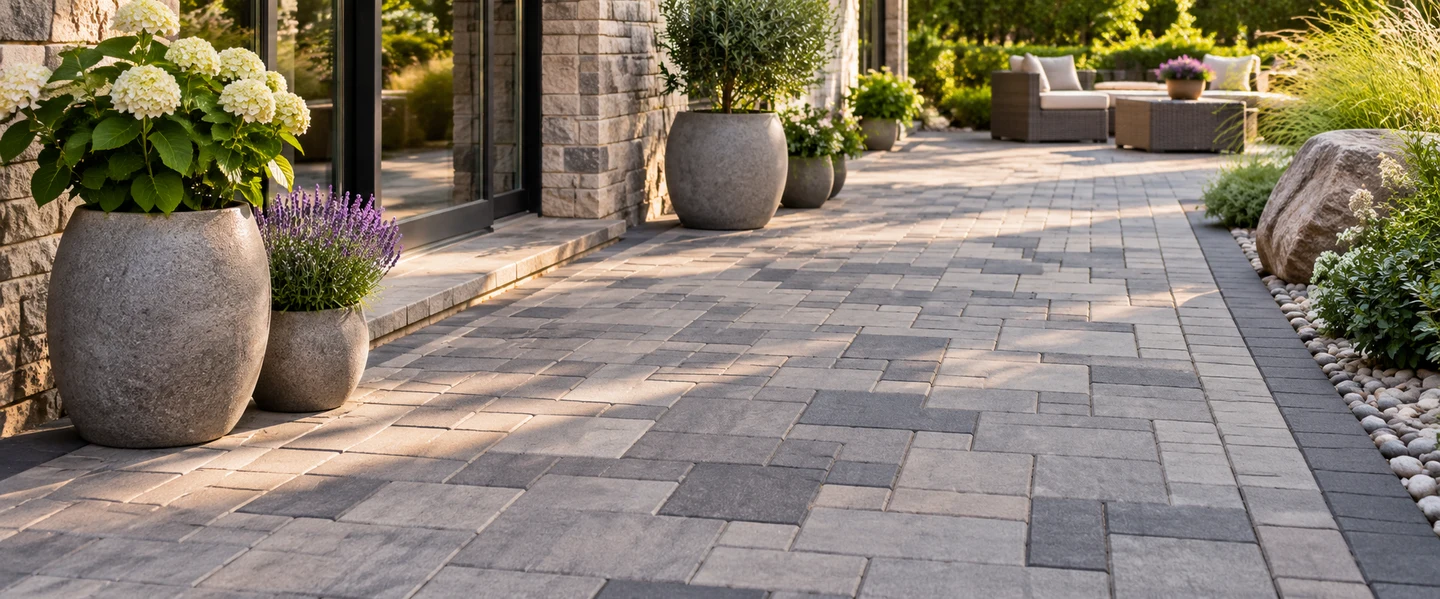
How to use
- Choose your market and measurement system.
- Add project areas and subtract exclusions without overlapping them.
- Enter actual paver dimensions, joint width and waste allowance.
- Choose individual pieces, packs or pallets; enter the capacity and price per purchase unit, together with design layer depths and material prices, if available.
- Review the automatic results; use Print estimate to save them or Reset example to restore the initial values.
Project calculator
Add distinct areas and subtract obstacles only once.
Pavers required
Results update automatically
Invalid data. Correct the fields.
Breakdown of purchased pieces
Missing prices are not zero. Delivery and labour are excluded.
From surface area to paver quantity
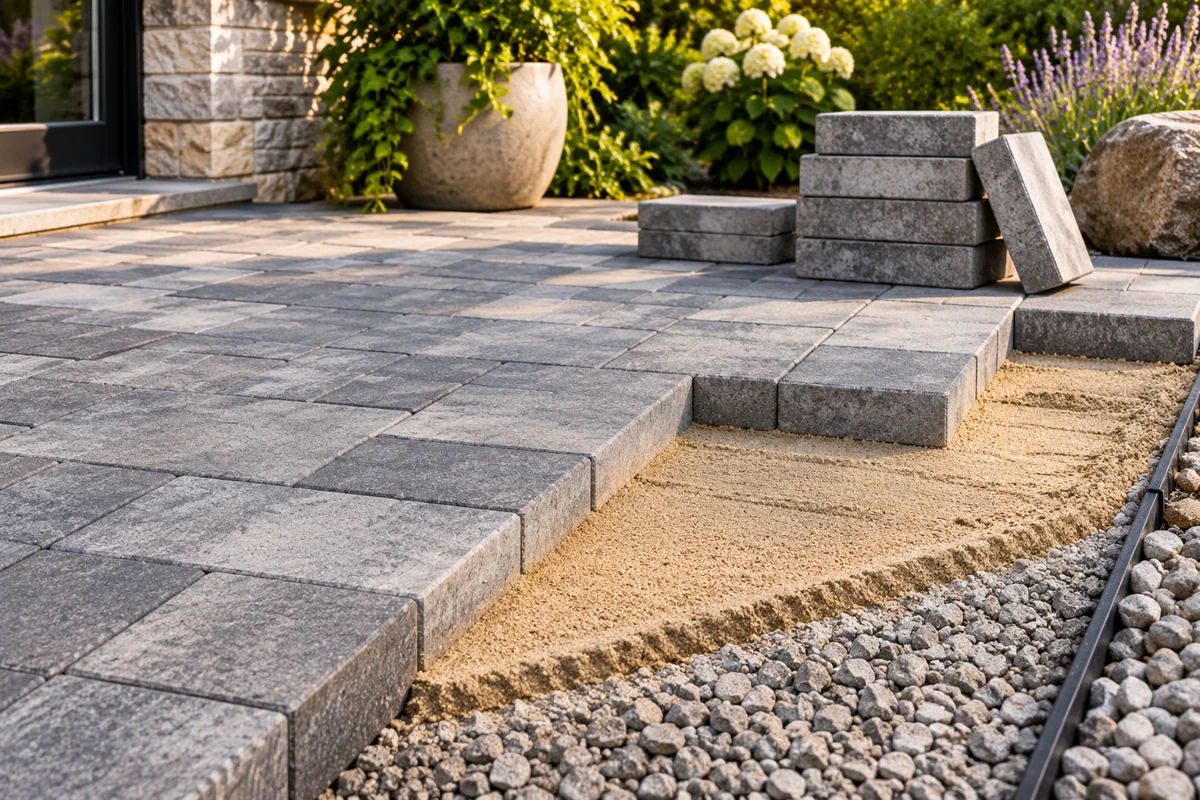
This calculator estimates the number of rectangular or square pavers, purchase units, geometric volumes of base material and bedding sand, and material costs. It is suitable for preliminary estimates for courtyards, patios, paths and outdoor surfaces.
Formulas and methodology
Rectangle area = length × width; circle = π × radius²; triangle = base × height ÷ 2; trapezoid = (longer parallel side + shorter parallel side) × height ÷ 2. Net area A is the sum of areas minus exclusions. The engine converts lengths to metres before calculation.
With L and W as actual dimensions in metres, j as joint width in metres and s as the waste percentage, the nominal module is (L + j) × (W + j). The number of pavers N includes waste and is rounded up to a whole number.
For packs or pallets containing q pieces, purchase units are U = ⌈N/q⌉, purchased pieces P = U × q, and purchased nominal coverage is P × (L + j) × (W + j). Extra pieces from rounding are P − N. Nominal coverage is not the same as the physical surface area of the pavers alone.
How many pavers do I need?
Divide the net area by the area of one paver including its joint, multiply by the waste factor and round up. A 20 × 10 cm paver with no joint allowance covers 0.02 m²: 50 pieces per m² before waste. For actual 8 × 4 in pavers without joints, the equivalent is 4.5 pieces per ft².
| Actual dimensions (cm) | No joint (pieces/m²) | 5 mm joint (pieces/m²) |
|---|---|---|
| 10 × 10 | 100 | 90.7 |
| 20 × 10 | 50 | 46.46 |
| 20 × 20 | 25 | 23.8 |
| 30 × 30 | 11.11 | 10.75 |
| 40 × 40 | 6.25 | 6.1 |
The figures are approximate purchasing ratios, not a laying plan. Round up the total project quantity, not each square metre. Add joints only if not already included in the nominal size.
Worked example
Consider a 5 × 2 m rectangle, with no exclusions, 20 × 10 cm pavers, 5 mm joints and 5% waste. The following depths and prices are illustrative inputs only, not installation recommendations or market quotations.
- Net area
- 5 × 2 = 10 m²
- Nominal module
- 0.205 × 0.105 = 0.021525 m²
- Required quantity
- ⌈10 ÷ 0.021525 × 1.05⌉ = 488 pavers
- Packs of 48
- ⌈488 ÷ 48⌉ = 11 packs, 528 pieces, 40 extra
- Purchased nominal coverage
- 528 × 0.021525 = 11.3652 m² (about 11.37 m²)
- Base, 15 cm
- 10 × 0.15 = 1.50 m³
- Sand, 3 cm
- 10 × 0.03 = 0.30 m³
- Illustrative cost
- 11 × €25 + 1.50 × €40/m³ + 0.30 × €50/m³ = €350
Second example: a 6 × 4 m surface with a 2 × 1 m internal flower bed has a net area of 22 m². With 20 × 10 cm pavers, no joints and no waste, the geometric estimate is 1,100 pieces.
US customary example: a 20 × 10 ft patio has 200 ft². With 8 × 4 in pavers, no joints and no waste, the geometric estimate is 900 pieces. A 6 in base requires 100 ft³ (about 3.7037 yd³), and a 1 in bedding layer requires about 16.6667 ft³ (0.6173 yd³). These are illustrative dimensions, not structural specifications.
Market settings: the US preset uses USD, feet, inches and cubic yards; the UK preset uses GBP, metres, millimetres and cubic metres. Canada, Australia and New Zealand use their own currencies, with a metric starting profile. You can independently change measurement system and currency. Changing market or currency clears prices; the measurement-system switch converts quantities and unit-volume prices. The market is suggested from your location, and you can change it at any time.
Pavers, base and sand
Each layer is calculated separately using the net area and entered depth. Paver waste is not automatically applied to bulk materials.
For the estimate: paver cost = purchase units × unit price; each layer cost = volume × price per unit of volume. The total is available only when all relevant prices are entered; otherwise the subtotal of known prices is shown.
Material reference guide
- Pavers
- Use actual dimensions, nominal module and manufacturer-declared coverage; mixed sizes require a specific laying plan.
- Base material
- Geometric volume at the specified design depth. The loose quantity to order depends on compaction, moisture and material density.
- Bedding sand
- Volume of the layer beneath the pavers, distinct from joint-filling sand.
- Joint sand and edging
- Not included: estimate separately according to geometry, product and installation method.
Common mistakes to avoid
- Confusing length or volume units, such as inches, feet, cubic yards, millimetres and metres.
- Counting overlapping areas twice or subtracting exclusions outside the project.
- Adding joint width to a module that already includes it.
- Treating waste allowance as a guarantee against all cuts: layout and boundaries may require different quantities.
- Entering a price per piece when buying by pallet, or confusing price per cubic metre with price per tonne.
- Treating geometric volume as the loose delivery quantity, or an example depth as a structural specification.
Technical limitations
The calculation does not check overlaps, actual row layout, drainage, slopes, bearing capacity, frost, local requirements or traffic resistance. It excludes excavation, edging, joint sand, delivery, labour and taxes not included in entered prices. Driveways and surfaces subject to significant loads require a design appropriate to local conditions and manufacturer instructions. Images are illustrative, not construction drawings.
Frequently asked questions
Why does joint width change the paver count?
A wider joint increases each unit's nominal footprint. Always confirm the manufacturer's declared module.
How do I calculate waste allowance?
Enter the percentage of extra pieces needed for your project; cuts and unusual shapes require a project-specific assessment.
How are packs and pallets rounded?
The number of purchase units is rounded up to the next whole number.
Can I use the calculator for mixed paver sizes?
Not directly: the model uses one rectangular format. For mixed patterns, use manufacturer-declared coverage or an estimate based on the laying plan.
Does the sand volume include joint filling?
No. The displayed volume is for the bedding layer only. Estimate joint sand separately.
What base depth should I use?
Use the depth specified by the design, considering soil, loads, drainage and applicable requirements. The calculator does not select a structural depth.
Why is the total cost not displayed?
One or more relevant prices have not been entered. The subtotal of known prices may not represent the full cost.
Does changing currency convert prices?
No. Changing country or currency clears entered prices so that amounts from different markets are not mixed. Enter actual supplier prices in the selected currency; no exchange rate is applied. Changing measurement system converts prices per unit volume without changing the currency or the estimated cost.
How do I check the final order?
Compare the result with coverage per pack, cuts in the laying plan and supplier instructions. Round up to actual purchase units.