

French Drain Materials Calculator
Estimate gravel, pipes, geotextile, excavation and costs for one or more underground drain sections.
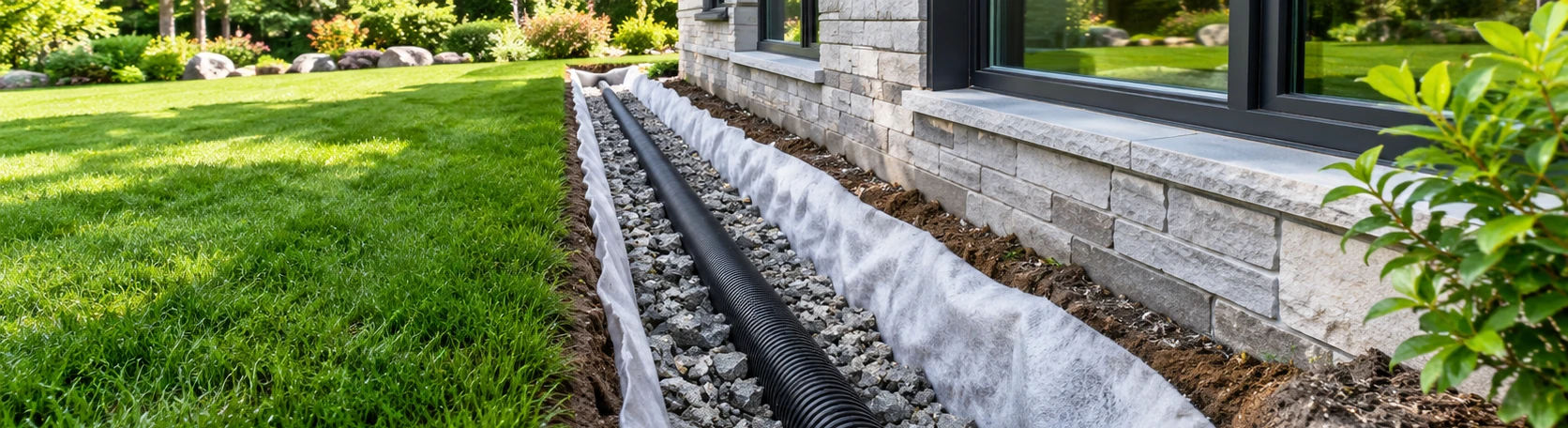
Quick calculation guide
- Choose market, currency and units.
- Enter length, width and depths for each section, outside pipe diameter, cover and ground fall.
- Set purchase modes, allowances and optional prices.
- Review the shopping list and print the estimate.
Physical quantities stay unchanged when units change. Prices are not converted between currencies.
Drain dimensions
Straight sections, rectangular cross-section. Do not double-count junction areas.
Materials and purchasing
Drainage gravel
Weight-based purchases require the supplier's declared bulk density.
Pipes
Filter geotextile
Rolls are allocated per section; offcuts are not assumed reusable.
Excavation, disposal and additional costs
All prices are entered by you. No automatic supplier quotes.
Gravel to order
Enter measurements to begin.
Drain cross-section · Section 1
Illustrative diagram; does not define bedding, clearances or installation methods.
Shopping list
| Material | Quantity |
|---|
Breakdown by section
Cost estimate
| Item | Cost |
|---|
Atlas Technical Guide
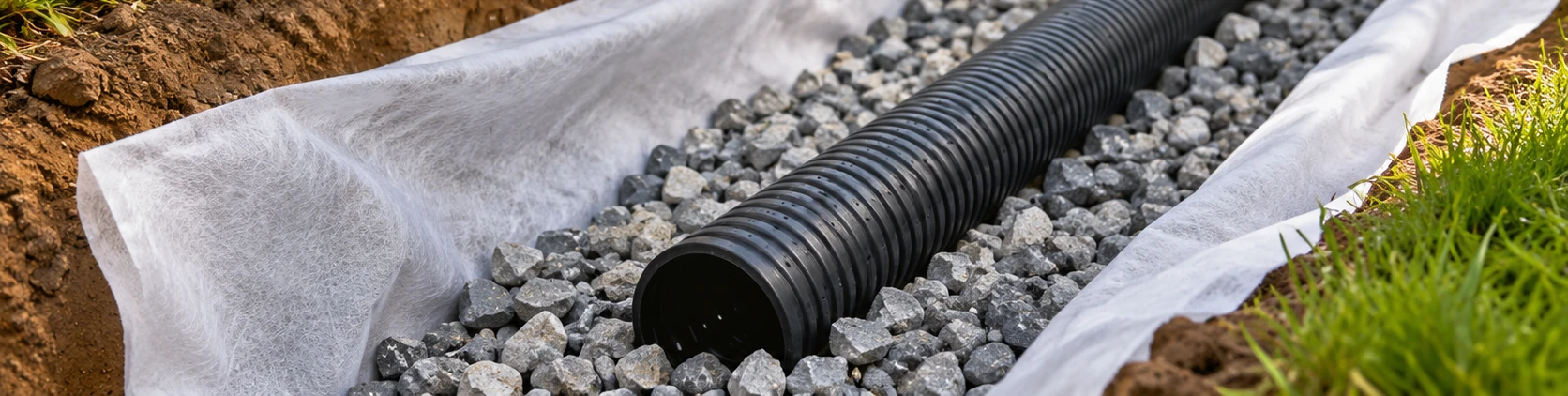
Gravel per foot or metre of French drain
A level trench 40 cm wide and 60 cm deep, with 10 cm soil cover and a 100 mm outside-diameter pipe, needs about 192 L of gravel per metre (0.077 yd³ per foot). Add appropriate allowances and check supplier density and pack sizes before ordering.
How much gravel do I need for a French drain?
US equivalent of the first metric example: 32.81 ft long, 15.75 in wide, 23.62 in deep, 3.94 in cover and 3.94 in outside pipe diameter; about 2.51 yd³ of installed gravel. Euro prices in the worked examples are illustrative arithmetic, not US, UK or other local quotes. Enter local prices in the selected currency.
Gravel volume is the drainage envelope excluding soil cover, minus the external displacement of the pipes. For example, a rectangular trench 10 m long, 40 cm wide and 60 cm deep, with 10 cm of cover and a pipe with 100 mm outside diameter, needs about 1.92 m³ of installed gravel. Without additional allowances, this equals 49 bags of 40 L. These are geometric quantities, not recommended system dimensions.
Materials and their purpose
A conventional French drain (land drain, weeping tile, ag pipe or draincoil in local terminology) intercepts subsurface water and conveys it towards a suitable outlet. The system typically combines permeable aggregate, a drainpipe and a filter. Actual selection depends on soil and design.
| Component | Information needed for the estimate |
|---|---|
| Gravel or crushed stone | Clean aggregate with grading compatible with the design and without excessive fines; supplier-declared bulk density. |
| Perforated pipe | Actual outside diameter, available lengths and compatible fittings. Nominal diameter is not necessarily outside diameter. |
| Filter geotextile | Compatibility with soil grading, permeability and strength; sufficient width for a complete wrap. |
| Cover and accessories | Design cover thickness; chambers, joints, end caps and connections counted separately. |
PNNL guidance explains the use of clean aggregate and a filter around the drainage envelope to limit migration of fine particles. Filter geotextile is not a waterproofing membrane. Prefabricated gravel-free systems are outside this model.
Formulas and methodology
Each section is straight, rectangular, constant in width and linearly varying in depth. Inputs are converted internally to metres and calculated at full precision. L is horizontal length, W width, D₀ and D₁ start and end depths, C cover, G ground fall (positive downhill), d outside diameter and N number of parallel pipes.
Usable height H = D − C
Excavation = L × W × D
Cover = L × W × C
Bottom fall F = G + D₁ − D₀
Grade (%) = 100 × F / L
Sloping length B = √(L² + F²)
Pipe displacement = π × d² / 4 × B × N
Installed gravel = L × W × H − pipe displacement
Positive fall means the bottom descends in the selected direction. Geometric grade does not verify flow rate, infiltration or outlet suitability. The calculator flags zero or reverse grade and rejects geometries where pipes do not fit the envelope. This does not guarantee adequate bedding or spacing.
Geotextile: why roll width matters
A complete wrap covers the bottom, both sides and the top. The engine uses the larger usable end height and adds longitudinal overlap O. T is the sloping top length and E is the cutting allowance at each end.
Cut width = 2W + 2Hmax + O
T = √(L² + G²)
Cut length = [max(B, T) + 2E] × (1 + fabric allowance / 100)
Cut area = width × length
Cut area is a conservative estimate, not just the net wall area. In roll mode the width must allow a full wrap without longitudinal seams. If more rolls are required, joint overlap is deducted from usable length. Allowances do not certify filter integrity; closure and connection details require design verification.
Purchasing quantities and cost estimate
Mass = order volume × bulk density
Bags = round up (quantity / bag capacity)
In-situ soil for disposal = excavation − reused cover
Loose disposal volume = in-situ volume × bulking factor
Weight requires a bulk density for the ordered material in its relevant condition, in kg/m³ or equivalent units. Loose volume factor and allowance are separate; do not count the same increase twice. Prices for bags, straight lengths and rolls apply to whole packages. Each pipe in each section is rounded separately, without automatic reuse of offcuts. Fabric rolls are allocated per section. This is conservative compared with an optimised cutting plan.
The known subtotal adds only entered prices; the total for selected items appears once all their prices are available. A missing price is not zero. Excavation, disposal, delivery, accessories and labor are not automatically included. Check taxes, minimum orders and supplier terms.
Reference table: gravel per linear metre
Constant cross-section, level ground and bottom, one 100 mm outside-diameter pipe, 10 cm cover, no additional allowance or factor. Dimensions are arithmetic examples, not construction specifications.
| Width × depth | Gravel per 1 m | Gravel per 10 m |
|---|---|---|
| 30 × 40 cm | 82.15 L | 0.821 m³ |
| 40 × 60 cm | 192.15 L | 1.921 m³ |
| 50 × 70 cm | 292.15 L | 2.921 m³ |
| 60 × 80 cm | 412.15 L | 4.121 m³ |
Example 1 — 10-metre section, bag purchase
L = 10 m, W = 0.40 m, D₀ = D₁ = 0.60 m, C = 0.10 m, G = 0, d = 0.10 m, N = 1. Fabric overlap 0.30 m and 0.20 m allowance at each end. No percentage allowance, volume factors of 1. Zero grade, so this is a quantity example only: it does not demonstrate that the drain works.
| Item | Calculation and result |
|---|---|
| Excavation | 10 × 0.40 × 0.60 = 2.40 m³ |
| Gravel | 2 − π × 0.10² / 4 × 10 = 1.92146 m³ |
| 40 L bags | 49 bags = 1.96 m³ purchased |
| Pipe | 10 m |
| Geotextile | 2.10 × 10.40 = 21.84 m² |
| Soil for disposal | 2.40 − 0.40 = 2.00 m³ (if cover is reused) |
| Illustrative cost | 49 × 5 € + 10 × 3 € + 21.84 × 2 € = 318.68 € |
Illustrative euro prices only; not local supplier quotes. Excludes excavation, disposal, accessories, delivery, labor and taxes.
Example 2 — Two separate sections, varying depths
Section A: 8 m × 0.35 m, depth 0.50 to 0.58 m. Section B: 5 m × 0.40 m, depth 0.60 to 0.65 m. Level ground, 0.10 m cover and 100 mm OD pipe for both. Sections do not overlap; no hydraulic continuity assumed. Both bottoms have 1% geometric grade. Overlap 0.30 m and end allowances 0.20 m.
| Item | Result |
|---|---|
| Total excavation | 1.512 + 1.250 = 2.762 m³ |
| Installed gravel | 1.169165 + 1.010728 ≈ 2.180 m³ |
| Order with 10% allowance | 2.398 m³; at 1,600 kg/m³ ≈ 3.837 metric tonnes |
| Pipe in 3 m straight lengths | 5 lengths, 15 m purchased for about 13.001 m required |
| Geotextile | 28.345 m² cut area; 2 rolls of 2.5 × 10 m (50 m² purchased) |
| Disposal | (2.762 − 0.480) × 1.2 = 2.7384 m³ loose |
| Illustrative cost | Gravel €172.65, pipes €60, fabric €56, two fittings €12, delivery €35: 335.65 € |
Gravel €45/metric tonne, loose volume factor 1; pipe lengths €12 each; rolls €28 each, joint overlap 0.20 m; fittings €6 each. No extra pipe or fabric allowance. Excavation, disposal and labor costs not entered. Density, euro prices, bulking factor and 1% grade are examples, not specifications or supplier quotes.
Common mistakes
- Using nominal rather than outside diameter or omitting displacement of multiple pipes.
- Confusing plan length with sloping length and ground fall with bottom fall.
- Double-counting excavation at section intersections.
- Buying fabric by area alone without checking width.
- Converting volume to weight using a density unrelated to the actual aggregate.
- Rounding packages down or treating a partial estimate as final cost.
- Assuming a geometric result proves drainage capacity or authorizes discharge.
Frequently asked questions
What diameter should a drainpipe have?
There is no universal diameter. Sizing depends on flow, soil, grade, pipe type and outlet. The calculator uses the entered outside diameter only for quantities and displacement.
What slope should a French drain have?
Slope depends on the system and site. The engine computes bottom fall relative to horizontal length and flags zero or reverse grade, without giving a universally valid design threshold.
How much gravel should I buy for 10 metres?
It depends on the usable section, pipe and allowances. The 40 × 60 cm example with 10 cm cover and 100 mm outside-diameter pipe requires about 1.92 m³ before allowances. Consult the table and enter actual measurements.
Can I use a generic gravel density?
For ordering by weight, use bulk density for the selected product in the relevant condition. Moisture, grading and voids change the weight-to-volume ratio.
Does the geotextile include the top?
Yes. The model estimates a complete wrap with overlap. The required width must fit the roll; longitudinal seams joining narrow sheets are not modelled.
How are straight lengths, bags and rolls calculated?
Packages are whole units. The engine rounds up and calculates pipes and fabric separately by section without automatically reusing offcuts. A professional cutting plan may reduce purchases.
Can I calculate multiple connected sections?
Yes, up to 100 straight sections. Do not double-count junctions. The calculator does not verify level continuity between sections or add chambers and fittings automatically.
Can I reuse excavated soil for cover?
Only if compatible with design and local conditions. When reuse is selected, the estimate deducts cover volume from disposal; it does not assess geotechnical suitability.
Why is there no total estimate?
A selected item is missing a price. The known subtotal remains available; do not treat it as a complete estimate. Re-enter prices after changing currency.
Is the calculator suitable for foundations, deep excavations or prefabricated systems?
It estimates only the rectangular geometry described. It does not design waterproofing, stability, flow, excavations or outlets, and does not accurately model gravel-free prefabricated systems. Consult a qualified professional for foundation work and complex sites.
Sources and editorial responsibility
Formulas are geometric deductions from the TroubleAtlas model and the examples have been verified with this calculator. The sources support technical explanations and risk context; they do not certify the software or provide site-specific advice.
- PNNL / Building America Solution Center — Footing Drain Pipe: aggregate, pipe and filtration around the drain.
- PNNL — Swales, Drains, and Site Grading: context for site water management.
- OSHA — Trenching and Excavation: excavation and buried utility risks (US reference).
- GOV.UK — Approved Document H: reference for relevant building work in England.
- Normattiva — D.Lgs. 152/2006: Italian water and environmental protection framework; check applicable provisions.
- NDS — EZflow: manufacturer example of a prefabricated system excluded from the model.
Regional guidance
Check discharge arrangements and permissions with the local authority. These references provide context, not permission to discharge water.
- Canada — Government of Canada: French drains, trench drains and weeping tiles
- Australia — Yarra City Council (Victoria): Legal Point of Discharge
- New Zealand — MBIE: E1 Surface water
- Deutschland — WHG § 55
- France — Code civil, article 640
- España — Código Técnico de la Edificación, DB HS
TroubleAtlas Technical Team · Updated . Internal editorial review, no independent professional certification. AI-generated illustrations.