

Gravel Calculator
Calculate how much gravel you need for a driveway, path or garden. Estimate cubic yards, cubic metres, tons, tonnes, bags and material cost.
Metric and US units · 24.11.2026
How to use
- Choose your country and units.
- Enter each area; subtract non-overlapping openings.
- Enter depth, supplier bulk density and waste allowance.
- Read volume and weight; add a quote, bag weight or truck payload for more detail.
Project calculator
Add positive areas and subtract openings. Exclusions must not overlap or extend outside the project.
Order volume
Results update automatically
Quantity breakdown
Cost is for the calculated loose quantity, not rounded bags or delivery.
How to calculate gravel
Multiply net area by the finished depth. Apply your supplier’s loose volume factor and your selected allowance to estimate the quantity to order.
Vorder = V × C × (1 + W/100)
M = Vorder × ρ
Weight depends on loose bulk density, grading and moisture. Ask the supplier for the density of the exact aggregate; a cubic yard is 0.764554857984 cubic metres.
Worked example
Metric example: 10 × 5 m, 10 cm depth, 10% waste, factor 1, illustrative density 1,600 kg/m³.
50 m² × 0.10 m = 5 m³
5 m³ × 1 × (1 + 10/100) = 5.5 m³
5.5 m³ × 1,600 kg/m³ = 8,800 kg
The sample density is illustrative, not a certified material value.
Choosing and ordering gravel
For a driveway, patio or garden path, measure the actual area and the planned finished depth. Split an L-shaped site into non-overlapping rectangles and subtract obstacles only once.
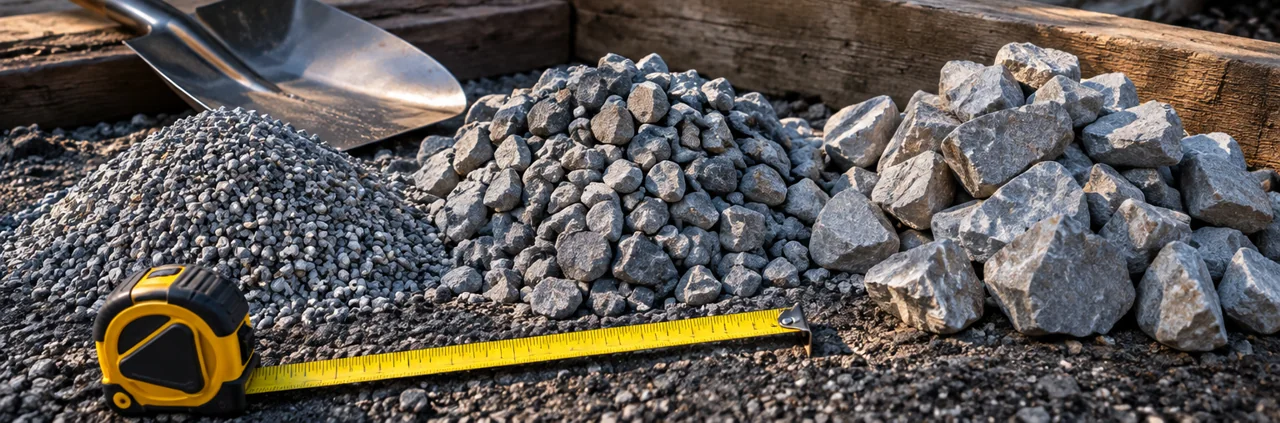
For crushed stone, pea gravel or decorative chippings, ask the supplier for delivered loose bulk density, not solid rock density. If the supplier provides a loose-to-finished volume factor, apply it to finished volume; keep the waste allowance separate to avoid double counting.
Confirm minimum orders, whether the quote is per cubic yard, cubic metre, US short ton or metric tonne, bag weight, delivery fees and truck access. This estimator does not specify structural thickness or drainage.
How much gravel do I need per square metre or square foot?
A 5 cm layer uses 0.05 m³ (50 litres) per m². At a sample loose bulk density of 1,600 kg/m³, a loose-volume factor of 1 and no waste, that is 80 kg. In US units, a 2 in layer over 100 ft² requires about 0.62 yd³ before allowances. Use the supplier’s actual density and ordering units.
| Depth | Placed volume | Illustrative mass |
|---|---|---|
| 3 cm | 0.03 m³ | 48 kg |
| 5 cm | 0.05 m³ | 80 kg |
| 8 cm | 0.08 m³ | 128 kg |
| 10 cm | 0.10 m³ | 160 kg |
| 15 cm | 0.15 m³ | 240 kg |
Illustration only: loose bulk density 1,600 kg/m³, factor 1, waste 0%. Depths are calculation examples, not installation specifications.
Worked example: driveway with an exclusion and a quote
An 8 × 3 m driveway minus a 2 m² obstruction gives 22 m². At 5 cm depth, placed volume is 1.10 m³. A factor of 1.10 and 5% waste gives 1.2705 m³ to order, or 2,032.8 kg at 1,600 kg/m³. That is 82 bags of 25 kg; at an illustrative rate of 50 GBP per metric tonne, loose material costs £101.64, excluding delivery and taxes not in the rate.
Frequently asked questions
How much gravel do I need?
Multiply net area by the finished depth. Apply your supplier’s loose volume factor and your selected allowance to estimate the quantity to order.
How much does a cubic yard of gravel weigh?
Weight depends on loose bulk density, grading and moisture. Ask the supplier for the density of the exact aggregate; a cubic yard is 0.764554857984 cubic metres.
Can I estimate gravel costs and bags?
Yes. Enter a price per volume or weight, and the bag mass or truck payload. Bags and loads round up; delivery charges and taxes are not included unless entered in the rate.
How many cubic yards are in a ton of gravel?
A US short ton is 2,000 lb. Divide 2,000 by the loose bulk density in lb per cubic yard. At an illustrative 2,700 lb/yd³, one US short ton is about 0.74 yd³. A metric tonne is 1,000 kg and is a different unit.
How do I convert cubic yards to US tons?
Multiply yd³ by the loose bulk density in lb/yd³ and divide by 2,000. For metric tonnes, use m³ × kg/m³ ÷ 1,000. US short tons and metric tonnes are different units.
How much area does one cubic yard or cubic metre cover?
At 2 in depth, 1 yd³ covers 162 ft²; at 5 cm depth, 1 m³ covers 20 m². These are geometric quantities before allowances; delivered loose volume may differ.
Can I estimate a driveway base layer?
Yes, once the required thickness of each layer has been specified. This is a quantity estimator, not a pavement design, load-bearing or drainage calculation.
How do I avoid counting compaction twice?
Use the delivered loose density and the supplier’s loose-to-finished factor. If your volume is already loose, do not apply that same adjustment again. Keep waste separate.